

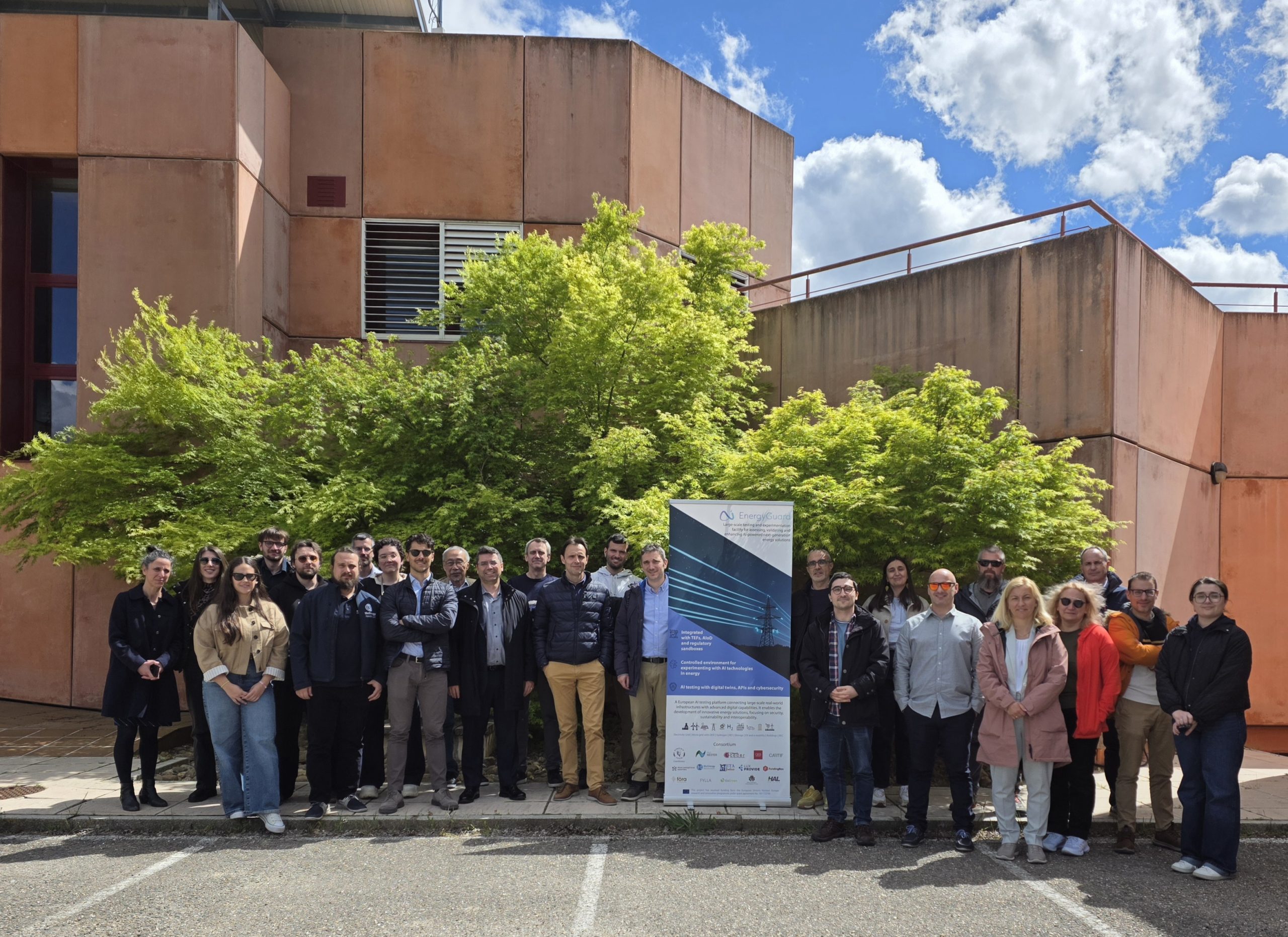
On 6-7 May, the 15-partner EnergyGuard consortium met in Soria, Spain. Hosted by partners CEDER-CIEMAT and föra, the meeting focused on the transition from foundational planning to building the actual testing environment. As EnergyGuard enters its second year, the focus has moved from designing individual technical nodes to building a functional Energy AI TEF (Testing and Experimentation Facility).
The goal is to create a secure environment where innovators can test their software against real-world physics across the entire energy value chain, including electricity, heating/cooling, and hydrogen energy vectors. The team focused on the “Minimum Viable Product” (MVP) – a step that moves the platform from experimental code toward a service ready for the market.
The Four Pillars of the EnergyGuard Service Ecosystem
To move from a collection of pilots to a unified industry resource, the consortium is organising its offering into four distinct blocks. These pillars define how the EnergyGuard platform will actually function for an external developer looking to build Trustworthy AI in energy.
- The Secure Data Lake: This is the project’s high-quality data repository. Partners are continuously contributing real-world telemetry that developers can use to train and improve their models.
- Digital Twins for Real-World Simulation: The project creates virtual copies of actual energy infrastructure, from hydrogen stacks to local energy communities. These Digital Twins allow users to run experiments and observe how their algorithms handle the messy, unpredictable fluctuations of a real network.
- High-Performance Computational Support: Large-scale energy experiments require massive processing power. The MeluXina supercomputer acts as the underlying engine for the platform, providing the heavy lifting needed for complex machine learning and data processing tasks.
- The Trustworthiness Benchmark: This pillar offers a self-assessment environment where developers can ensure their solutions strictly comply with the EU regulatory framework, specifically targeting mandates like the EU AI Act and GDPR. Innovators can guarantee their tools are market-ready and built to withstand regulatory and investor scrutiny.
The “Test-Before-Invest” Journey: How to Test AI Solutions for the Energy Sector
The project is moving towards a “test-before-invest” model designed to help developers move from a prototype to a market-ready product. This approach allows small companies and researchers to access high-end tools, such as the MeluXina supercomputer, which are usually too expensive for anyone but the largest utilities. By using the platform, an innovator can check if their software works as intended before committing to a full-scale rollout.
Grounding the Digital in Reality
While much of the work is digital, the project relies on physical facilities to act as ground-truth anchors. During the meeting in Soria, the partners visited the CEDER-CIEMAT microgrid centre to see the hardware that supports the virtual models. Seeing the physical battery storage and hydrogen electrolysers in person was a reminder of the real-world constraints the software must handle.
This visit was essential for the work on Digital Twins. To make a virtual copy useful, it has to accurately reflect the physics of the actual equipment. By using data from sites like CEDER-CIEMAT, the technical teams can calibrate their simulations to ensure they behave like the real grid. This link between the physical and the digital offers a safe but realistic environment for testing new energy technologies.
The Road Ahead for 2026
The focus now turns to the first full release of the technical framework. The technical teams are working towards a major milestone this year, where more pilots will be integrated into the platform. This involves moving the current tools from their testing domain to the main project platform to make them easier for the industry to access.
To ensure the services meet the actual needs of the market, the project is launching a campaign to find external testers. This “test-before-invest” phase is scheduled to run early 2027. By joining the Supportive Partners Network now, organisations can help shape the final service portfolio and be among the first to use the platform. The project is also mapping out regional innovation hubs across Europe to ensure these testing tools are available to as many local energy communities and startups as possible.
The work done in Soria has provided a shared timeline for the months ahead. As the project continues, the goal remains to turn these technical discussions into a functioning infrastructure that supports a more resilient and decarbonised power grid.