
Testing and Experimentation Facilities (TEF) as the new path for bringing Innovation to Market
AI and digital solutions often stall at the pilot stage due to lack of validation environments, data access, or trust. EnergyGuard as a bridge between research, innovation, and market deployment uses Europe’s greenest high-performance computing infrastructure, Meluxina, which supports the execution of complex AI models and simulations. Additionally, EnergyGuard offers a robust digital ecosystem featuring data lakes, curated assets, inference APIs, and an AI development environment. This infrastructure facilitates seamless integration with European data spaces and digital innovation hubs, fostering collaboration and innovation.
However, since the energy sector, the journey from prototype to market-ready product is long and risk-heavy, we are also focusing on testing the market via Techfinders platform for Early Adopters.
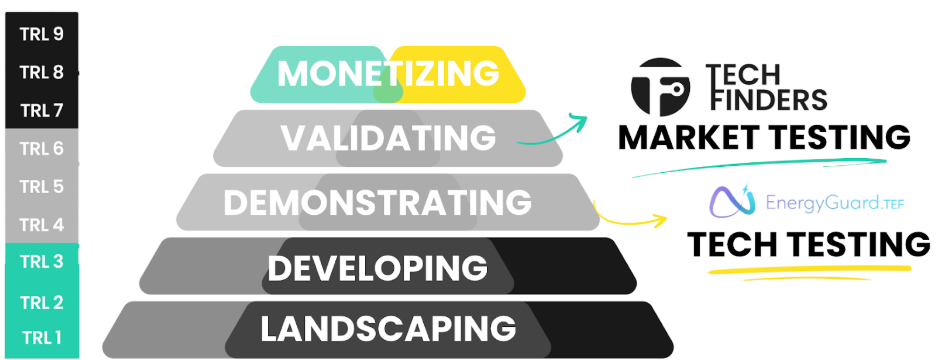
Every innovation needs proof — not only that it works, safely, efficiently, and at scale. Where EnergyGuard provides the testing ecosystem, but also that there is a real market demand for it, where Techfinders.io intervenes.
Technology Validation: Why It Matters for the Energy Transition
“We must learn what customers really want, not what they say they want or what we think they should want” – Eric Ries
Innovations are engines of change, consequently, EnergyGuard TEF was established to ensure AI Energy solutions succeed. But what is the definition of success? Innovative tech solutions success is defined by time. In the context of venture capital, such products can only be considered a success when they grow into large companies in a short span of time. If a startup never grows large, or if they take a long time to grow large, the startup is not a success. This means that the risk investors must consider is not about the viability of the technology itself. Instead, the risk is if the journey to market and scaleup will take too long.
At EnergyGuard TEF we are aware that the risk stems emerging from four main sources.
- Team risk. The team cannot ensure fast growth.
- Market risk. The chosen customer segment does not support fast growth.
- Product risk. The product does not provide enough value to enable fast growth.
- Funding risk. The access to funding is too restricted to finance fast grow.
All startups have these four types of risk but in addition startups also usually hold specific risks that are related precisely to the technology or the market they are developing. When startups “do not succeed”, it is because they succumb to one or more of the sources of those abovementioned Risks.Our aim at EnergyGuard TEF is to provide a necessary infrastructure to de-risk and accelerate the technology development and its go-to-market launch. For this reason we have included into our toolbox not only the high-performance computing infrastructure, Meluxina, which supports the execution of complex AI models and simulations, but also Techfinders.io platform which helps the emerging solutions to match and get feedback from the Early Adopters. This combined approach helps the AI tech solutions in the Energy field to be tested from technical and from market point of view at the same time accelerating their future uptake in one holistic approach.
EnergyGuard’s infrastructures role
EnergyGuard TEFs offers a comprehensive set of infrastructures and services aimed at supporting the development and validation of AI technologies for the energy sector across the European Union. We operate five large-scale facilities located in different European countries, including Portugal, Spain, France, Italy, and Latvia.
These facilities simulate a variety of energy environments such as transmission networks, microgrids, hydrogen systems, digital twins of urban buildings, and renewable energy communities.
They provide a real-world testing environment capable of running complex AI models and simulations for startups, SMEs, and researchers to validate AI applications in diverse energy contexts.This infrastructure supports AI-driven research and innovation by providing the computational power needed for energy-related AI tasks.
Covering all the necessary digital testing ecosystem that provides access to data lakes: centralized repositories for storing large amounts of structured and unstructured data related to the energy sector, curated assets: data and tools that are pre-processed and ready for use in AI models, Inference APIs: APIs that allow the seamless integration of AI models with real-world data for real-time decision-making, as well as AI Development Environment: Tools and platforms for building, training, and deploying AI models within the energy sector.
All those resources are integrated with European Data Spaces and digital innovation hubs, promoting cross-border collaboration and data exchange which enables stakeholders to access and share relevant data to drive innovation in energy AI applications.
During this testing phase the AI Testing & Evaluation (performance, robustness, bias), Cybersecurity & Safety Assessment, Interoperability and Compliance Checks, Simulation with Digital Twins and Performance Benchmarking using HPC may be performed.
Overall, EnergyGuard’s infrastructure and services provide a holistic environment that enables the testing, validation, and scaling of AI technologies to drive sustainable and efficient energy solutions across Europe. But, is it enough to achieve the go-to-market readiness? Not really. We need one more magical ingredient to meet our Early Adopters.
MARKET TESTING Techfinders.io platform role
To complete the de-risking technology landscape Techfinders.io completes the EnergyGuard journey by introducing a market validation element which is a crucial step in the innovation process, ensuring that new technologies and services are feasible, practical, and market-ready. It involves systematically evaluating a technology’s functionality, performance, and alignment with industry needs under real-world conditions.
But, why is it so important?
Validating technology helps identify potential flaws or limitations early and it reduces risks, by facing ‘early’ issues before scaling. It is also the perfect way to align with customer needs. Validation provides an opportunity to engage with potential users, incorporating their feedback into the development process.
Aligned with what is mentioned above, it also builds market confidence by providing credibility to the technology, as it has been demonstrated to be tested and compliant with industry standards.
Techfinders.io platform offers to EnergyGuard collaborators the process to understand whether there’s real demand for the product in the market. By validating the ideas, we can anticipate if the end users are likely to purchase EnergyGuard tested solutions and if its businesses has the potential to become profitable.

This kind of validation is a critical stage where the applicability and market readiness of technology are assessed through use cases, replicability analysis (mentioned above), and “test-before-invest” experiments.
This step is essential to bridge the gap between technological promise and real-world market needs. This structured approach fosters the successful commercialization of innovative technologies, particularly in the domain of AI solutions for energy markets.
This validation stage stands as a critical checkpoint within the innovation funnel, determining whether a technology is viable and has a strong product-market fit.
In the context of emerging technologies, the process of validation involves the creation of use cases, which serve as concrete examples of how a technology can be applied to address industry needs. Through use cases, emerging technologies prove their relevance in real market conditions.
Techfinders.io isn’t just about testing — it’s about earning market trust.
Strengthening Europe’s Energy AI Ecosystem
The European Union is committed to fostering trustworthy AI technologies, aligning with its AI Strategy and AI Act, which aim to ensure that AI development and deployment are safe, ethical, and transparent. These initiatives emphasize the importance of AI solutions that respect fundamental rights, promote innovation, and enhance societal well-being.
In this context, Europe’s Energy AI Technologies Ecosystem is a rapidly evolving landscape where innovative solutions are being developed to address the challenges of energy efficiency, sustainability, and grid management.
The ecosystem includes cutting-edge AI research, startups, and large-scale industry players focused on transforming the energy sector through data-driven technologies. The EnergyGuard project significantly contributes to this ecosystem by offering a unique infrastructure for testing and validating AI solutions in real-world energy settings.
By providing access to its extensive testing facilities and leveraging high-performance computing, EnergyGuard enables emerging European research teams and startups to refine their AI-driven solutions.
Additionally, Techfinders.io acts as a platform to engage early adopters, allowing startups to test and showcase their innovations, gather feedback, and validate market potential before their official go-to-market launch. This integration of testing, validation, and early user engagement adds significant value by accelerating the adoption of new technologies and ensuring they meet industry standards and market needs.